NO. 64 - FIRE - THE SCOURGE OF ALRESFORD
by Peggy Mckerracher.
 Alresford is a town that seems to have
been singularly unlucky in the number of
times it has been destroyed by fire. The
design of the buildings, the materials
used (wattle, daub and thatch) and the
fact that the main water supply was from
the river where it runs through the Sake, apart from
houses with wells, only Mill Hill and the
lower end of Broad Street had a water supply
for extinguishing any fire, and the worst
fires seem to have been in West Street
well away from this supply.
Alresford is a town that seems to have
been singularly unlucky in the number of
times it has been destroyed by fire. The
design of the buildings, the materials
used (wattle, daub and thatch) and the
fact that the main water supply was from
the river where it runs through the Sake, apart from
houses with wells, only Mill Hill and the
lower end of Broad Street had a water supply
for extinguishing any fire, and the worst
fires seem to have been in West Street
well away from this supply.
The houses were timber framed, thatched with straw, which was plentiful after harvesting and kept the house warm in winter and cool in summer.
A hot, dry summer meant that an unlucky spark from a domestic fire would cause havoc. The risk was increased by the fact that they were built close together, and the buildings including bakers shops, smithies, breweries and tallow chandleries, all requiring the use of fire, apart from heating and cooking. This necessitated the storing of wood and furze on the premises for fuel, and all furniture was made of wood also. Some houses did not have a chimney of brick or stone, which did not prevent the lighting of fires in spite of heavy fines on those with dangerous flues, so once fire had taken hold it was almost impossible to check flames especially in a strong wind, when sparks and burning fragments could be carried some distance.
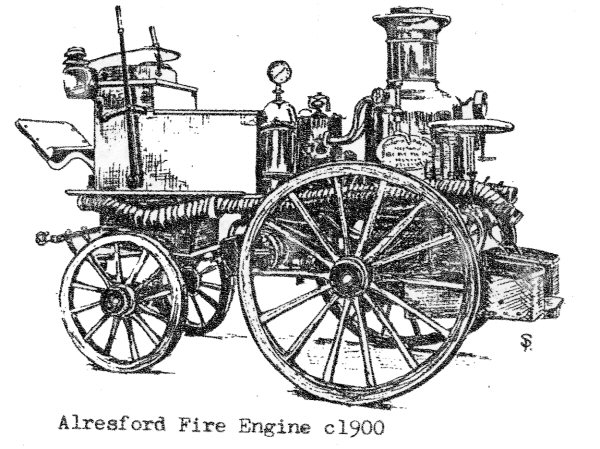
Such fire-fighting equipment as there was could not deal with fires properly. Until the late 17?th century it consisted of leather buckets to douse the thatched roofs, and long fire hooks to pull thatch from buildings in an endeavour to prevent the spread of fire. The co-operation of neighbours was required in this, as home and possessions were at stake. Eventually fire engines, manually operated, were available to check a small blaze, but were virtually useless otherwise. There was such an engine in Alresford, kept in the church tower. A machine was built in 1721, which had some advantage, but a fire amongst buildings of timber and thatch caused such fierce heat and smoke that no one could get near enough with water to extinguish it, as the machine put up only a short stream of water, and was called a squirt as a consequence.
After the fire of 1736, which destroyed most of West Street, it was decided that Alresford should be re-built in brick and tile. Winchester which had its fair share of fires, having carried out a similar policy almost 100 years before, in 1656, when any occupier not complying within twelve months was fined £10. 'Old Timbers' Mill Hill is the only house to have escaped all these fires, and is virtually unchanged except for its slate roof.
The first recorded fire was in 1160, seventh year of the reign of Henry II, before the Great Weir and Alresford Pond was created. The whole town was destroyed.
In 1440, in the time of Henry VI after an outbreak of plague had killed many townspeople and left the place almost deserted and destitute a fire occurred thought to have been caused by inflammable infected bedding being burnt.
The next major fire was in 1610, cause unknown, but the reed thatch and lack of fire-fighting equipment meant the quick spread of it unchecked. Another which started at The Swan destroyed the greater part of West Street in 1620.
After the Battle of Cheriton in 1644 we have the first documented evidence of the cause of the fire. The town was occupied by Royalist troops and when word came that the Roundheads were approaching, the Royalists evacuated. On the way they fired West Street on both sides, but the Roundheads put out the fires as they advanced.
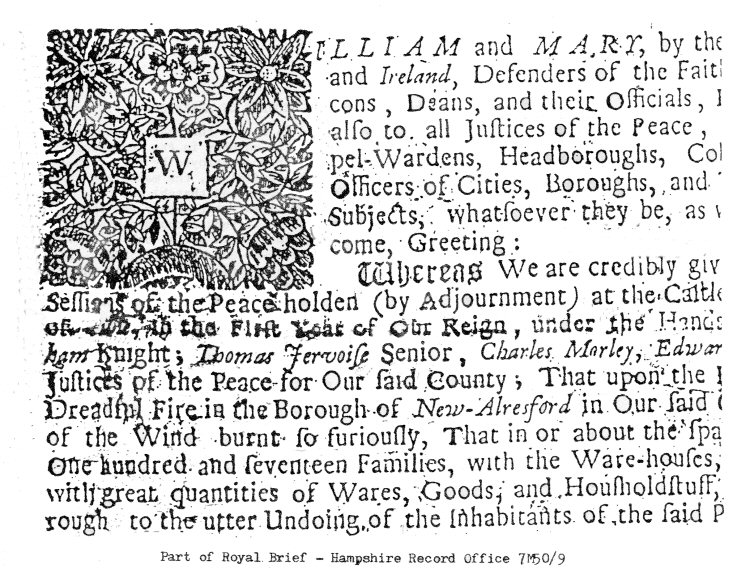
1689 saw one of the worst fires in the history of Alresford, when almost the whole town together with the Church and Market House was consumed by fire. That it originated by design rather than accident was indicated from its breaking out in three different parts at once. The fire lasted three hours and the value of property and possessions destroyed was £24,000 a heavy burden on the town which caused William III and Mary to grant said poor sufferers free power, licence and authority to ask, gather and receive alms and charitable contributions not only householders but servants, strangers and others in all and every cities, towns and parishes throughout England and Wales, and Berwick on Tweed, towards their relief?and they appointed trustees and receivers to administer funds. The distribution of the money raised was often corrupt and the issue of a Brief was sometimes delayed by an enquiry into the actual losses which was required before collections could be authorised. The May 1689 recompense was delayed until April 1691 for this reason.
The 10th Report of the Historical Manuscripts Commission records - "May 2nd 1689. George Bridges, a justice of the peace for the county of Southampton, to all constables and other officers thereof. Mary Collins late of Dublin, has this day testified before him that she was lately in the company of 67 Irishmen and 6 Irishwomen who pretend them selves to be distressed Protestants forced out of Ireland, but that they are now dispersed into several companies. She declared upon her oath that their object in coining to England was to set towns and houses on fire, that they have set fire to several houses in a town near Sherborne, that then intended to set fire to the City of Winchester, and that on the 1st of this May they set the town of New Alresford on fire, so that the whole of it was consumed. The names and descriptions of five of these men are appended. All the company are well armed, and their women carry their fire-balls. The hue and cry is to be raised after them".
Most dwelling houses as well as the church and market were shortly rebuilt and business pursued as usual. Trade increased and although the number of dwellings did not exceed 170, Alresford was said to pay a larger sum in duty to the King, than did the City of Winchester.
Fire broke out again in 1736, on April 30th, when a public brew- house belonging to Thomas Newell, on the north side of West Street, caught fire and was destroyed before the fire was brought under control. Although it happened in the daytime and help was at hand, a brisk north westerly wind carried the flames across the street, to several thatched buildings so rapidly that inhabitants had no time to save their possessions. In about five hours the fire consumed the brewhouse and buildings, with all stores of malt, hops and utensils, all dwelling houses, malt-houses, barns, stables, and outhouses of 17 inhabitants together with goods, wares, stocks of hay and corn, beans, large .quantities of beer in vaults and cellars, working tools and implements.
Thirty others suffered great damage to their houses and contents. Again sufferers were supported by charity administered by local trustees, to the extent of £4 5 GOG.
In 1792 another fire started at The Swan, caused by the horse- keeper taking a lighted candle to the stable, without a. lantern, and setting fire to straw. The fire did not spread to the rest of the town, but eight fine carriage horses were suffocated by smoke.
On February 13th 1813, again in West Street, a fire started in a malt kiln, but fortunately there was no wind and the inhabitants put the fire out quickly, assisted by several French prisoners, who were billeted in the town. Poor people who could not afford to rebuild their homes were forced to become tramps and wandered round the countryside begging from the better off.
No more large conflagrations are recorded for almost 100 years, until May 1907, when fire broke out at Alresford Union Workhouse, in the block of buildings housing the women and children, and rapidly spread towards the master's quarters. The Union bell was rung to summon help to move the older inmates and the children. Dense smoke caused by a burning clothing store hampered rescue attempts and at great risk to his own life, the master battled with fire and smoke to fetch the last occupants, a woman and child, in a bed at the far end of a ward. The porter had to go into Alresford to call the Volunteer Fire Brigade. Water was in fairly good supply from a rainwater tank in the yard and two tanks on the roof, one of which was eventually melted by the heat. The Brigade fought the fire for seven hours, because once again wind fanned the flames. The roof crashed in, and the walls could be heard cracking in all directions, so there was no time to save anything from the Master's quarters. It was reported that the Master, Matron and assistant Matron so energetically saw to the rescue of their charges, that they lost everything, and insurance policies to safeguard their possessions had not been completed. Many people sent clothing and took in sufferers. It was remarked that 'restoratives for those who might be burned or overcome by the smoke were kindly sent by Mr. Willis'. Obviously not cups of tea!
Fire has transformed Alresford into the town we know now, with handsome Georgian style houses in the three main streets, partly the effect of re-building and partly as the result of rules made to attempt to reduce fire risk. Nowadays, gas or electricity is used for cooking rather than open fires, and in all factories, theatres and public places as well as transport, fire extinguishers are put where they can be easily seen, and fire escapes and fire doors ensure that people can get away from the scene of the fire. Our ancestors were not so lucky.
Copyright Peggy McKerracher October 1989
Sources :Historical Manuscripts Commission
Dwellings in Alresford - Dr. I. Sanderson
History of Alresford - A.J. Robertson
Private Papers.